从单体到微服务:COLA架构与Spring Cloud Alibaba的无缝集成实践指南
你是否还在为微服务架构落地时的复杂配置而头疼?是否在寻找一种既能保证代码整洁性,又能快速实现业务功能的解决方案?本文将带你探索如何通过COLA架构与Spring Cloud Alibaba的深度整合,构建一个高内聚低耦合的微服务系统,让你在30分钟内完成从架构设计到服务上线的全流程。
读完本文你将获得:
- COLA架构与Spring Cloud Alibaba的最佳集成实践
- 基于DDD思想的微服务分层设计指南
- 可直接复用的服务通信与配置管理代码模板
- 完整的微服务构建与部署流程
COLA架构:整洁代码的微服务基石
COLA(Clean Object-Oriented and Layered Architecture)作为一种"整洁面向对象分层架构",其核心价值在于通过严格的分层设计降低系统复杂度。从COLA v5开始,架构已进化为更灵活的领域驱动设计模式,将应用划分为接口适配层(Adapter)、应用层(Application)、领域层(Domain) 和基础设施层(Infrastructure) 四个核心部分。
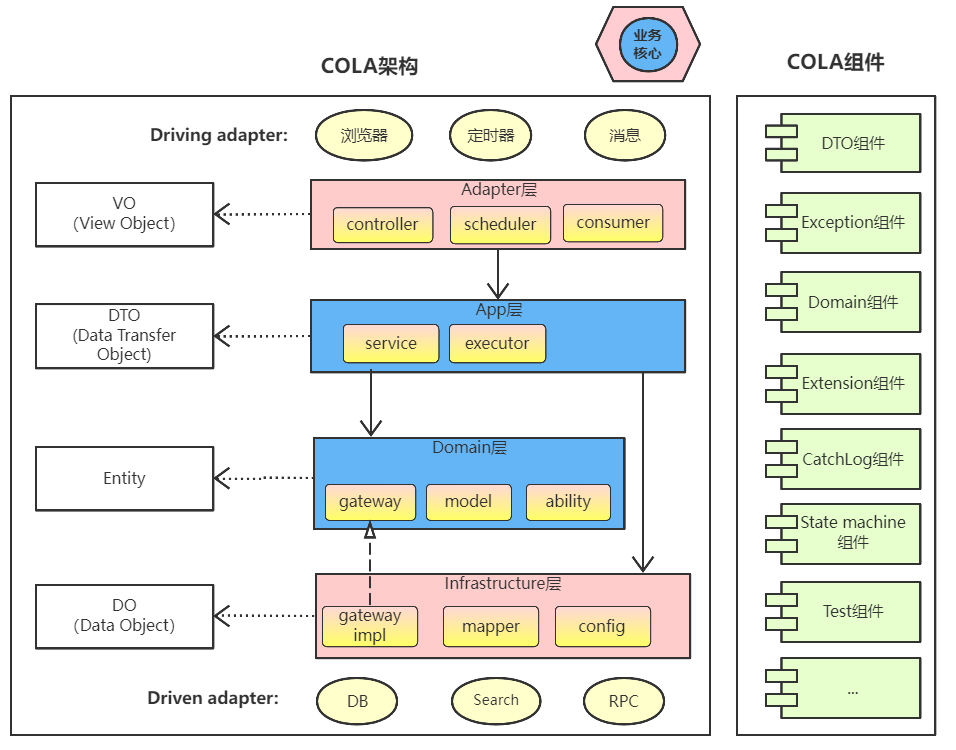
这种架构设计带来三大优势:
- 业务与技术解耦:领域层专注业务规则,技术细节被隔离在基础设施层
- 扩展能力增强:通过cola-component-extension-starter实现插件化扩展
- 测试效率提升:借助cola-component-test-container实现快速单元测试
COLA提供的archetypes模板能帮助开发者一键生成符合架构规范的项目结构,目前支持两种类型:
cola-archetype-service:纯后端服务模板cola-archetype-web:Web应用一体化模板
Spring Cloud Alibaba集成方案
Spring Cloud Alibaba作为微服务生态的重要组件,提供了服务发现、配置管理、流量控制等核心能力。将其与COLA架构结合,可形成"业务架构+技术架构"的双重保障。
集成架构设计

如上图所示,典型的集成架构包含以下关键组件:
- Nacos:服务注册中心与配置中心
- Dubbo:基于RPC的服务通信框架
- Sentinel:流量控制与熔断降级
- COLA核心组件:提供领域驱动能力
快速集成步骤
1. 创建COLA项目
使用Maven archetype生成基础项目结构:
mvn archetype:generate \
    -DgroupId=com.example.micro \
    -DartifactId=cola-micro-demo \
    -Dversion=1.0.0-SNAPSHOT \
    -Dpackage=com.example.micro \
    -DarchetypeArtifactId=cola-archetype-service \
    -DarchetypeGroupId=com.alibaba.cola \
    -DarchetypeVersion=5.0.0
生成的项目结构如下:
cola-micro-demo/
├── src/main/java/com/example/micro/
│   ├── adapter/        # 接口适配层
│   ├── application/    # 应用服务层
│   ├── domain/         # 领域层
│   └── infrastructure/ # 基础设施层
└── pom.xml
2. 添加Spring Cloud Alibaba依赖
在生成的pom.xml中加入Spring Cloud Alibaba坐标:
<dependencyManagement>
    <dependencies>
        <!-- COLA组件依赖管理 -->
        <dependency>
            <groupId>com.alibaba.cola</groupId>
            <artifactId>cola-components-bom</artifactId>
            <version>5.0.0</version>
            <type>pom</type>
            <scope>import</scope>
        </dependency>
        <!-- Spring Cloud Alibaba依赖管理 -->
        <dependency>
            <groupId>com.alibaba.cloud</groupId>
            <artifactId>spring-cloud-alibaba-dependencies</artifactId>
            <version>2022.0.0.0</version>
            <type>pom</type>
            <scope>import</scope>
        </dependency>
    </dependencies>
</dependencyManagement>

<dependencies>
    <!-- Nacos服务发现 -->
    <dependency>
        <groupId>com.alibaba.cloud</groupId>
        <artifactId>spring-cloud-starter-alibaba-nacos-discovery</artifactId>
    </dependency>
    <!-- 配置中心 -->
    <dependency>
        <groupId>com.alibaba.cloud</groupId>
        <artifactId>spring-cloud-starter-alibaba-nacos-config</artifactId>
    </dependency>
    <!-- COLA核心依赖 -->
    <dependency>
        <groupId>com.alibaba.cola</groupId>
        <artifactId>cola-component-dto</artifactId>
    </dependency>
    <dependency>
        <groupId>com.alibaba.cola</groupId>
        <artifactId>cola-component-exception</artifactId>
    </dependency>
</dependencies>
核心功能实现
领域层设计
以运营商计费系统为例,我们首先在领域层定义核心业务模型和规则。创建com.example.micro.domain.model包,实现计费相关实体:
// 通话记录实体
@Entity
public class CallRecord {
    private String callId;
    private String callerId;
    private String calleeId;
    private LocalDateTime startTime;
    private LocalDateTime endTime;
    private CallType callType; // 主叫/被叫

    // 计算通话时长
    public Duration getDuration() {
        return Duration.between(startTime, endTime);
    }
}

// 套餐领域服务
@Service
public class PackageService {
    private final PackageRepository packageRepository;

    // 计算费用核心逻辑
    public Bill calculateFee(CallRecord record, UserPackage userPackage) {
        // 根据不同套餐类型计算费用
        if (userPackage instanceof FamilyPackage) {
            return calculateFamilyPackageFee(record, (FamilyPackage) userPackage);
        } else if (userPackage instanceof FixedDurationPackage) {
            return calculateFixedPackageFee(record, (FixedDurationPackage) userPackage);
        } else {
            return calculateBasicPackageFee(record);
        }
    }

    // 其他业务方法...
}
应用层实现
在应用层实现用例编排,协调领域对象完成业务功能:
@Service
public class BillingApplicationService {
    private final PackageService packageService;
    private final BillRepository billRepository;
    private final NotificationClient notificationClient;

    @Transactional
    public SingleResponse<BillDTO> createBill(CreateBillCmd cmd) {
        // 1. 转换DTO为领域对象
        CallRecord record = CallRecordConverter.toEntity(cmd);

        // 2. 调用领域服务计算费用
        UserPackage userPackage = userPackageRepository.getByUserId(cmd.getUserId());
        Bill bill = packageService.calculateFee(record, userPackage);

        // 3. 持久化结果
        Bill savedBill = billRepository.save(bill);

        // 4. 发布领域事件
        eventPublisher.publish(new BillCreatedEvent(savedBill));

        // 5. 调用外部服务
        notificationClient.notifyBillCreated(savedBill);

        return SingleResponse.of(BillConverter.toDTO(savedBill));
    }
}
接口适配层实现
通过Dubbo暴露服务接口,实现COLA的Adapter层功能:
@RestController
@RequestMapping("/api/billing")
public class BillingController {
    private final BillingApplicationService billingService;

    @PostMapping("/calculate")
    public SingleResponse<BillDTO> calculateBill(@RequestBody CreateBillCmd cmd) {
        return billingService.createBill(cmd);
    }
}

// Dubbo服务暴露
@DubboService(version = "1.0.0")
public class BillingDubboService implements BillingService {
    private final BillingApplicationService billingService;

    @Override
    public BillDTO calculateBill(CreateBillCmd cmd) {
        return billingService.createBill(cmd).getData();
    }
}
基础设施层实现
集成Nacos配置中心,实现配置动态更新:
@Configuration
public class NacosConfig {
    @Bean
    public ConfigService configService() throws NacosException {
        Properties properties = new Properties();
        properties.put(PropertyKeyConst.SERVER_ADDR, "nacos-server:8848");
        return NacosFactory.createConfigService(properties);
    }
}

// 配置类
@ConfigurationProperties(prefix = "billing")
@Component
public class BillingConfig {
    private int maxRetryTimes;
    private boolean enableDiscount;
    private Map<String, String> feeRates;

    // Getters and setters...
}
扩展能力实现
利用COLA的扩展点机制,实现业务规则的插件化扩展。例如,为不同运营商定制计费规则:
// 定义扩展点接口
public interface BillingExtPt extends ExtensionPointI {
    Bill calculateSpecialFee(CallRecord record, UserPackage package);

    // 扩展点坐标
    default String getBspId() {
        return ExtensionCoordinate.DEFAULT_BSP_ID;
    }
}

// 中国移动扩展实现
@Extension(bizId = "CMCC", useCase = "BILLING", scenario = "SPECIAL_RATE")
public class CmccBillingExt implements BillingExtPt {
    @Override
    public Bill calculateSpecialFee(CallRecord record, UserPackage package) {
        // 中国移动特殊计费规则
    }
}

// 中国联通扩展实现
@Extension(bizId = "CUCC", useCase = "BILLING", scenario = "SPECIAL_RATE")
public class CuccBillingExt implements BillingExtPt {
    @Override
    public Bill calculateSpecialFee(CallRecord record, UserPackage package) {
        // 中国联通特殊计费规则
    }
}

// 在领域服务中使用扩展点
@Service
public class PackageService {
    private final ExtensionExecutor extensionExecutor;

    public Bill calculateFee(CallRecord record, UserPackage userPackage) {
        // 先尝试调用扩展点
        Bill specialBill = extensionExecutor.execute(
            BillingExtPt.class,
            () -> userPackage.getOperatorId(), // 根据运营商ID选择扩展实现
            ext -> ext.calculateSpecialFee(record, userPackage)
        );

        if (specialBill != null) {
            return specialBill;
        }

        // 默认计费逻辑...
    }
}
测试与部署
单元测试
使用COLA提供的测试容器快速编写单元测试:
@SpringBootTest
public class BillingApplicationServiceTest {
    @Autowired
    private BillingApplicationService billingService;

    @MockBean
    private PackageService packageService;

    @Test
    public void should_calculate_correct_fee() {
        // 准备测试数据
        CreateBillCmd cmd = new CreateBillCmd();
        cmd.setUserId("user123");
        cmd.setCallId("call456");
        cmd.setCallType("OUTGOING");
        cmd.setStartTime("2023-09-01T10:00:00");
        cmd.setEndTime("2023-09-01T10:05:00");

        // Mock领域服务返回
        Bill mockBill = new Bill();
        mockBill.setAmount(new BigDecimal("2.5"));
        when(packageService.calculateFee(any(), any())).thenReturn(mockBill);

        // 执行测试
        SingleResponse<BillDTO> response = billingService.createBill(cmd);

        // 验证结果
        assertTrue(response.isSuccess());
        assertEquals(new BigDecimal("2.5"), response.getData().getAmount());
        verify(billRepository).save(any());
    }
}
服务部署
通过Docker容器化部署服务,编写Dockerfile:
FROM openjdk:17-jdk-slim
WORKDIR /app
COPY target/cola-micro-demo.jar app.jar
EXPOSE 8080
ENTRYPOINT ["java", "-jar", "app.jar"]
集成效果验证
完成集成后,我们可以通过以下方式验证系统功能:
- 服务注册验证:访问Nacos控制台查看服务是否成功注册
- 配置动态更新:修改Nacos配置项,观察系统是否实时生效
- 流量控制测试:通过Sentinel控制台配置限流规则,验证保护效果
- 扩展点测试:调用不同运营商的计费接口,验证扩展规则是否正确执行
总结与展望
COLA架构与Spring Cloud Alibaba的集成,实现了"整洁架构+微服务"的双重优势。通过本文介绍的方法,开发者可以快速构建既符合业务架构规范,又具备微服务弹性能力的应用系统。
未来,我们将进一步深化集成,实现:
- 基于COLA事件机制与RocketMQ的分布式事务解决方案
- 利用状态机组件cola-component-statemachine实现复杂流程编排
- 通过cola-component-ruleengine实现业务规则的可视化配置
希望本文能为你的微服务实践提供有价值的参考。如有任何问题或建议,欢迎通过项目issue系统进行交流。
提示:完整代码示例可参考COLA计费系统样例,包含详细的业务实现和测试用例。
 atomcodeClaude Code 的开源替代方案。连接任意大模型,编辑代码,运行命令,自动验证 — 全自动执行。用 Rust 构建,极致性能。 | An open-source alternative to Claude Code. Connect any LLM, edit code, run commands, and verify changes — autonomously. Built in Rust for speed. Get StartedRust0448
 源启盛夏_AtomGit暑期开发者成长计划「源启盛夏」暑期校园开发者成长计划旨在激活校园开源力量,通过积分激励、认证扶持、资源倾斜等形式,引导高校组织和开发者完成「入驻 — 建项目 — 做贡献 — 获认证 — 得资源」的完整闭环。无论你是想带领社团入驻平台的组织者,还是希望用代码贡献证明自己的开发者,都能在这里找到属于你的成长路径。Markdown00
 jiuwenswarmJiuwenSwarm 是一款基于openJiuwen开发的智能AI Agent,它能够将大语言模型的强大能力,通过你日常使用的各类通讯应用,直接延伸至你的指尖。Python0769
 Hy3Hy3 是由腾讯混元团队研发的快慢思考融合的混合专家模型,总参数量 295B,激活参数 21B,MTP 层参数 3.8B。4 月底发布 Hy3 Preview 后,我们在 50 多个业务中获得了广泛的反馈,修复了各种体验问题,进一步提升了后训练的质量和规模。今天,我们发布 Hy3。它展现出显著强于同尺寸并比肩旗舰(参数规模往往是 Hy3 的 2~5 倍)开源模型的智能水平,显著提升了在各类产品和生产力任务中的实用价值。Python00
 AscendNPU-IRAscendNPU-IR是基于MLIR(Multi-Level Intermediate Representation)构建的,面向昇腾亲和算子编译时使用的中间表示,提供昇腾完备表达能力,通过编译优化提升昇腾AI处理器计算效率,支持通过生态框架使能昇腾AI处理器与深度调优C++0313
 DragonOSDragonOS is an operating system developed from scratch using Rust, with Linux compatibility. It is designed for **Serverless** scenarios. 使用Rust从0自研内核,具有Linux兼容性的操作系统,面向云计算Serverless场景而设计。Rust00

项目优选
 docs
docs kernel
 ops-nnpytorchops-transformer
 kernelAscendNPU-IRjiuwenswarmcannbot-skillscann-learning-hub